
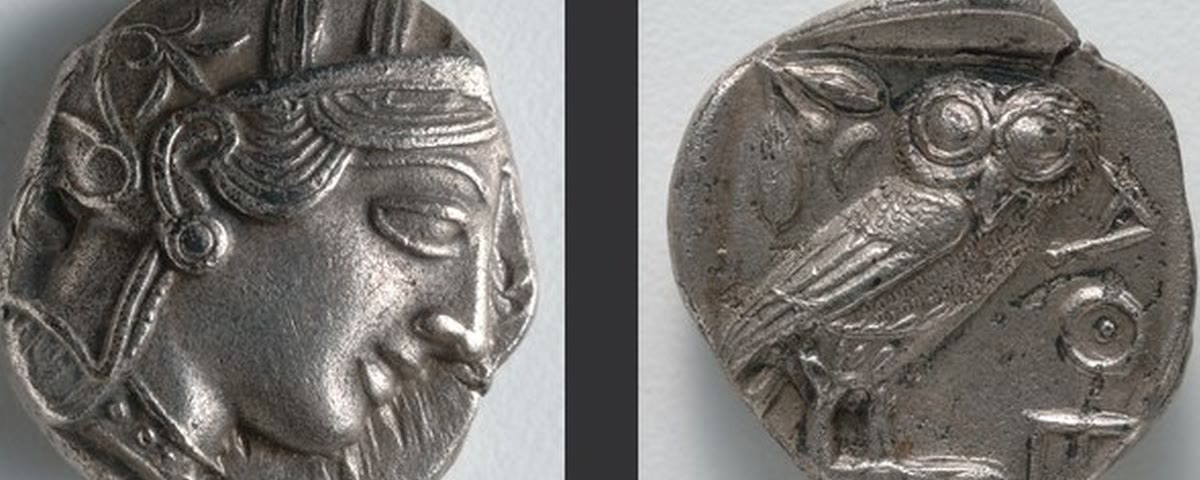
A stranger in an Aegean port could accept a familiar Athenian owl faster than a lump of anonymous bullion. Greek city-states turned mines and mints into a commercial network, and Athens gave it a face: silver from Laurion, struck into the owl tetradrachm, a known weight that crossed the sea without a letter of introduction. Whoever held the mine held fiscal power. Laurion helped pay for fleets and public life.
The stamp itself came from the east — Lydia and the first coins is where the punch first hit metal. Greece shows what happened when many city mints and many trade routes came to share one metal language.
City mints, not one empire mint
Classical Greece was a world of poleis — cities with their own laws, their own gods, and often their own coin. Aeginetan turtles, Corinthian pegasi, and Athenian owls were different types on related silver habits. Weight standards differed: Aeginetan, Attic, and others. Traders learned the types the way later merchants learned foreign coins — by familiarity, and by the scale when familiarity failed.
Colonies and trading posts carried Greek coin habits around the Black Sea, into southern Italy and Sicily, and along the Levantine coast. Silver was not only Athenian. Athens is simply the best-documented case, because Laurion and the Athenian empire left a thicker written trail.
The network was the point. A trader in a port could take a known tetradrachm faster than unmarked bullion. That is Lydia’s logic at Mediterranean scale. Exchange tables and money-changers still mattered where standards differed; the typed coin narrowed the argument to which city’s silver you held.
Laurion and Athenian fiscal power
The Laurion mines, in the south of Attica, produced silver that Athens coined and spent. Ancient accounts tie Laurion to naval power — above all to the decision, after a rich strike in the early fifth century BCE, to build a large fleet. Tonnage figures are debated. The chain is not: mine, mint, pay, ships and citizens.
A city with its own silver could pay without waiting for taxes in kind. Coin wages and coin payments built a public economy that looked different from a palace handing out grain. Laurion was a strategic asset.
Enslaved labour, underground galleries, and refining workshops made the district an industrial landscape by ancient standards. Output rose and fell with the veins, with war, and with management. When production dropped or war cut off the mines, Athens felt it in the treasury. Silver supply was policy as much as geology.
Other Greek regions had mines too. Laurion is remembered because of what Athens did with it: a democracy that coined its mountain into sea power and public pay.
The Attic owl tetradrachm
The Athenian tetradrachm — Athena on one side, an owl and an olive sprig on the other — became a widely trusted silver piece of roughly seventeen grams on the Attic standard. Its design stayed stable enough that markets from the Aegean to the Near East recognised it. That recognition was infrastructure.
The owl was shorthand for a claim: this much silver, this fineness, this city’s reputation. Counterfeits existed, and so did testing. The type still lowered the cost of checking compared with unmarked metal. Later imitations and eastern copies show how far the design traveled as a brand of silver weight.
Fame was not monopoly. Other cities coined. Persian sigloi, and later Alexander’s coinage, circulated in the same silver world. The owl simply ties mine, mint, and Mediterranean circulation together in one object.
A stable design mattered as much as a beautiful one. A merchant who saw the same Athena and the same owl year after year could price a cargo without a fresh assay on every bag. That is Lydia’s lesson at commercial scale.
Trade, tribute, and what silver did
Silver paid mercenaries, bought timber and grain, and settled balances between cities. Tribute under Athenian leadership arrived in coin or was converted into it. Temples stored wealth; markets spent it. The metal moved as public finance and as private trade at once.
Gold existed, and mattered for large reserves and for dealings with the east. But everyday Greek money talk was silver talk. Silver’s value per weight suited commercial trade; gold packed more value into less mass. Greece built its network on the everyday metal.
Ports from Sicily to the Black Sea priced cargoes in familiar silver weights. That shared language sits between Lydia’s stamp and Rome’s two-metal state. The Aegean taught strangers to settle in typed silver before a single empire tried to run gold and silver together under fiscal strain.
A short timeline
- Archaic period: Greek cities adopt coinage after the Lydian and Ionian habit; several weight standards in use.
- Early 5th century BCE: Laurion wealth tied to Athenian naval expansion in the literary tradition.
- Mid-5th century BCE: Owl tetradrachms circulate widely; tribute and trade settle in silver.
- 4th century BCE and after: Macedonian and Hellenistic coinages overlay and extend the silver language.
A typed silver language
Laurion and the owl turned a mine and a design into a settlement language for the whole Mediterranean. The next test of that language came in Rome, where one state ran gold and silver side by side and, under the pressure of paying armies, slowly thinned the silver — Rome: denarius, aureus, slow debasement.
Two thousand years later another mountain, on another continent, would flood the world with silver on a scale Athens never saw. That is Potosí.