
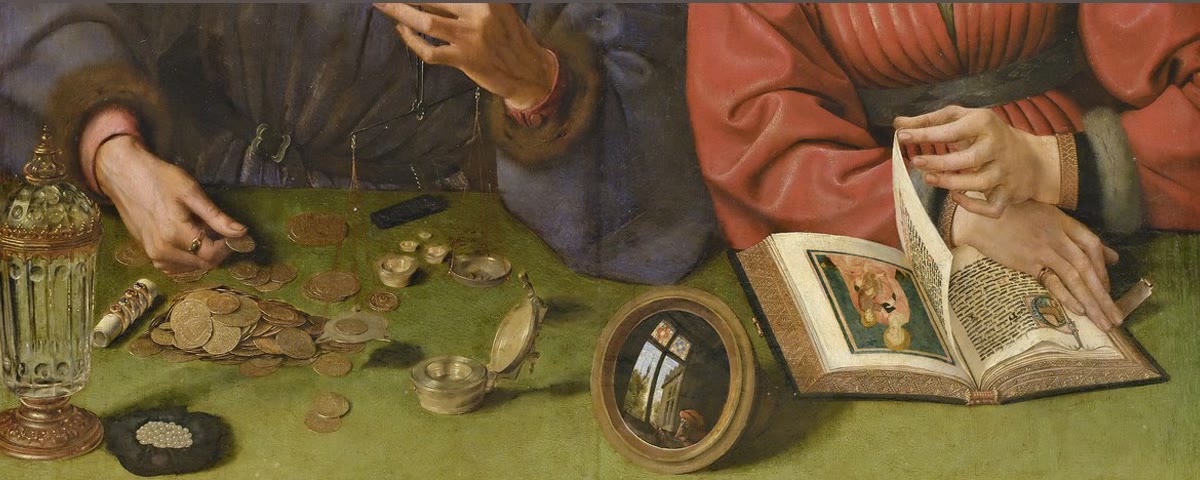
Long before anyone struck a coin, traders in Mesopotamia settled large debts in silver by weight. They counted in shekels, and a shekel was a weight, not a coin. Along the Levant, ingots, rings, and cut pieces changed hands as hacksilver — metal taken by the scale. Egyptian gold did the same work at a higher value. Nobody had decreed any of it. The two metals had won a long contest against everything else people tried.
Coinage came much later, as a faster way to check the metal. The metal came first. The stamp came second.
Cattle, grain, shells, copper
Plenty of things have been money close to home. Cattle settled a fine in a village that already priced in livestock, grain paid a tax if the collector took it before it spoiled, cowries moved along coasts, and copper and bronze served as small change where the sums were small. When the trade is near and everyone knows the goods, people use what is at hand.
Distance breaks those goods. An ox cannot settle a debt two seas away. Grain rots. Shells vary. Copper is useful, so it gets used up, and it is bulky for a large payment. A unit that has to travel, wait a year, and still be accepted by a stranger who never saw where it came from needs different qualities.
A ruler can name what his tax office will take. That is power over a till. It does not make a distant trader hold the named thing overnight. When a unit failed in the hand — too heavy, too perishable, too easy to fake, too easy to grow — trade drifted to something else. Again and again, it drifted to gold and silver.
Why cattle and grain lost
Economists later wrote the reasons down as six properties. Each one is a job a payment has to do when the other side is a stranger and the money may sit for a year.
Durability is why a debt can wait out a generation. Gold does not rot and does not rust in ordinary air, and silver tarnishes while the metal remains, whereas grain, cattle, and cloth do not offer that pause. A store of value is first a store. The thing must still be there.
Divisibility is how the same debt gets paid without slaughtering an ox. Metal can be cut, weighed, and recast, so one lump settles a large claim and still leaves a remainder, while a live animal or a finished cloth is ruined by being divided. Change is how a unit works at more than one size of payment.
Homogeneity, once the metal is refined, is why one ounce can stand in for another. Cattle are not interchangeable, shells vary, and mixed copper is a guess. When pieces of the same fineness are alike, weight becomes a language, and the scale replaces the argument about which cow or which lump.
Scarcity is why a king cannot harvest a new stock from a field when the treasury is short. Gold and silver are costly to find and to refine. The stock can grow — mines open, and one mountain would later flood a century with silver — but it does not appear because someone needs it this afternoon. Scarcity here means costly expansion, not a pile that never changes.
Recognizability is what lets a stranger tell the metal from a look-alike without a letter of introduction: color, weight in the hand, the streak on a touchstone, the ring of a good piece. The tests were crude. They were cheap enough to use at a distance, which mattered more than hiring an assayer for every bargain.
Portability is value per weight, and it is why a small mass of gold can settle a large debt while silver, heavier for the same purchasing power, became the everyday metal of Mediterranean trade and gold stayed the metal of large sums. Both still beat cattle on a ship and grain in a wagon.
The six work together. A durable metal that cannot be divided is jewelry. A scarce metal no stranger can recognize is a rumor. A portable metal a king can plant is a season’s money. Gold and silver were the overlap that survived contact with people who did not share a temple, a harvest, or a law.
Two metals, two jobs
Gold and silver were never the same instrument. Gold packs more value into a smaller weight. It suited tribute, treasuries, and large settlements. Silver sat closer to daily trade: enough value to be worth carrying, enough bulk that ordinary payments did not come down to dust. Ancient economies often used both, with copper or bronze underneath for the smallest change. That was a habit of scale, not yet a legal ratio.
Much later, governments would write a fixed ratio between the two into law, and then watch the pattern that carries Gresham’s name when the market ratio moved: the metal the law overvalued stayed in circulation, and the other left. That fight was about metals already in use. Traders had the split long before any state named it. It came from the properties themselves — the same durability and sameness, a different value per weight.
Metal first, mint later
Paying by weight is slow. Scales, touchstones, and arguments about fineness are the price of using anonymous metal in a market of strangers. A stamp is a claim about weight and fineness. It does not create the metal. It cuts the cost of checking it.
In Lydia, in western Anatolia, in the seventh and sixth centuries BCE, someone struck a lump of electrum — a natural mix of gold and silver — with a punch, and later with a design. That is the conventional start of struck coinage. The invention was the mark, not the ore. You still had to trust whoever made the mark. You no longer had to weigh every lump.
The stamp moved trust. It did not abolish it. When the design was honest, coin traveled farther than hacksilver. When the coin was lightened, people went back to the scale or hoarded the better pieces. Greek silver, Roman debasement, and a gold coin that held its weight for centuries all came after the mint. None of them is where metal became money.
Neither is 1971, when the United States stopped redeeming dollars in gold for foreign treasuries. By then gold had been money for thousands of years. The warehouse receipt — paper claiming a pile of coin somewhere else — came long after people trusted the pile. Gold and silver were in the bag before either existed.
Then the mark
So the order runs like this. Markets chose the metal. Then a mint put a mark on it, so strangers could skip the scale. Lydia and the first coins is where that punch lands. The rest of ancient money — Athens’ silver owls, Rome’s thinning denarius, Constantine’s solidus — runs on a choice traders had already made.