
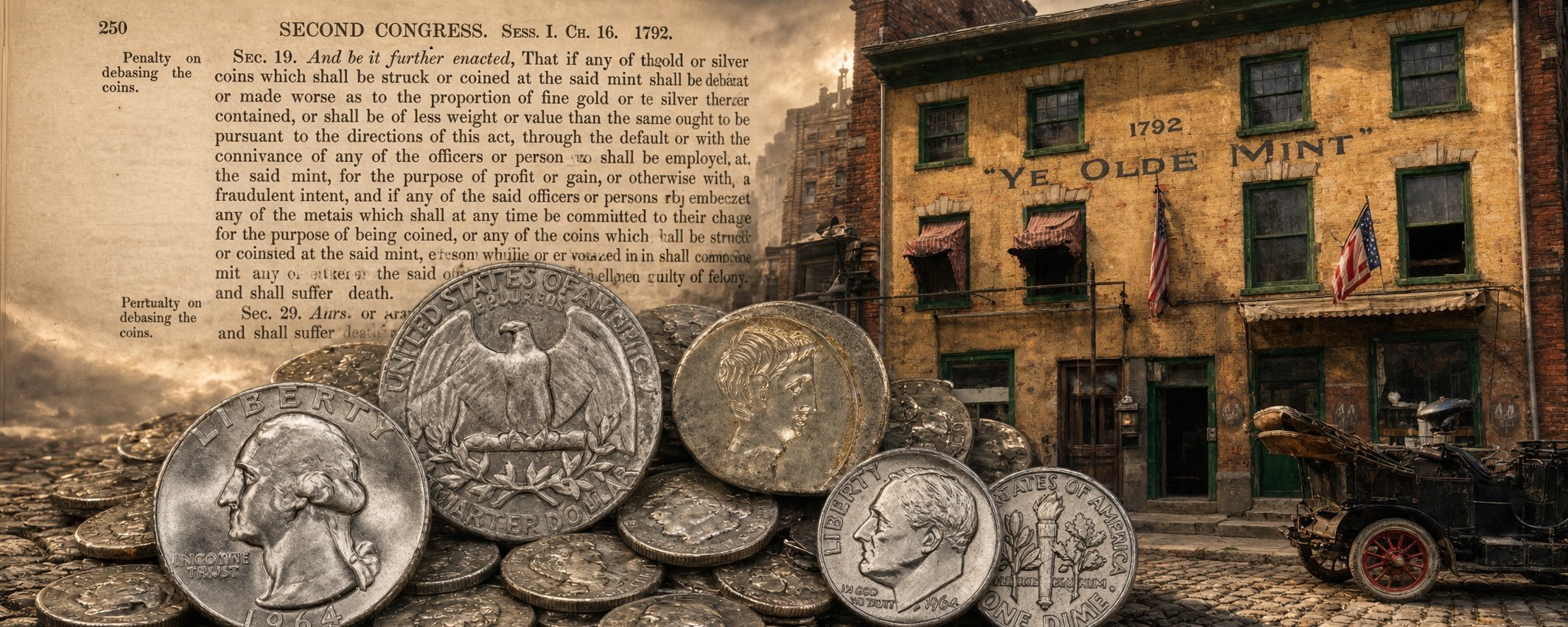
In the spring of 1792, Congress wrote a death sentence into a law about money. The crime was not treason or murder. It was shaving the silver out of the nation's coins.
A death sentence in a coinage statute is the fact. The crime named at the start is shaving silver out of the coins. Treason and murder are the crimes it was not.
Back almost eighteen centuries
To see why the lawmakers were that harsh, you have to go back almost eighteen centuries, to Rome. The coin that starts the story is the denarius.
Almost eighteen centuries before 1792 is the distance the article gives. The Roman denarius is the silver coin that distance points to.
A coin that was the metal
The denarius was Rome's everyday silver coin. It paid soldiers, settled market debts, and carried the emperor's face to every corner of the empire. Under Augustus, a denarius was about 95 to 98 percent pure silver. If you held one, you held the metal itself.
Everyday means soldiers' pay and market debts, not a rare piece kept in a box. The emperor's face is what traveled with the coin. About 95 to 98 percent pure is the figure given for a denarius under Augustus. The metal itself is the point of that percentage: the coin and the silver were nearly the same thing.
Less metal, same face
Then the bills came in. Armies on long frontiers, payments to troops, and the cost of running an empire kept rising, and the treasury struggled to keep up. So emperor after emperor found a quieter way out. They debased the coin. Debasing means putting less precious metal into each coin, mixing in cheaper copper, while keeping the same face and the same official value. Every coin looked like money. Each held a little less of what made it money.
The bills named are armies, troop payments, and the cost of the empire. The quieter way is the debasement: less precious metal, more copper, the same face, the same official value. Looked like money, and held less of what made it money, is the article's pair of sentences. The card set in after that explanation puts an Augustan denarius beside a later coin, so the loss of silver is visible.
The antoninianus
By around 270 AD the denarius had been pushed aside by a newer coin, the antoninianus. Romans treated it as a double denarius, worth two of the old coins. Under Gallienus and Claudius II, it held about 5 percent silver or less. Many were bronze coins with a thin silver wash on the surface, a bright skin that wore off in the hand and showed the copper beneath.
Around 270 is the date given for the change of coin. A double denarius means the new coin was treated as worth two of the old ones. About 5 percent silver or less is the figure for the reigns of Gallienus and Claudius II. A silver wash is a thin skin of silver on bronze. It wore off in the hand, and the copper showed.
One batch at a time
The coin had gone from almost pure silver to mostly copper in about three centuries. Nobody passed a law announcing it. It happened one batch of coins at a time.
About three centuries is the span from the Augustan denarius to that later coin. No announcing law is the article's contrast. One batch at a time is how the change is described.
A fixed weight, and a penalty
The men who built the American republic had read their Roman history. When Congress passed the Coinage Act of 1792 and set up a national mint, it defined the dollar by a fixed weight of silver. Then it guarded that weight with the harshest penalty in the whole act.
Read their Roman history is why the article puts Rome before Philadelphia. The Coinage Act of 1792 sets up the mint and defines the dollar by a fixed weight of silver. The early U.S. coinage is that statute and the coins that followed. The harshest penalty in the act is the one the next lines quote.
Section 19
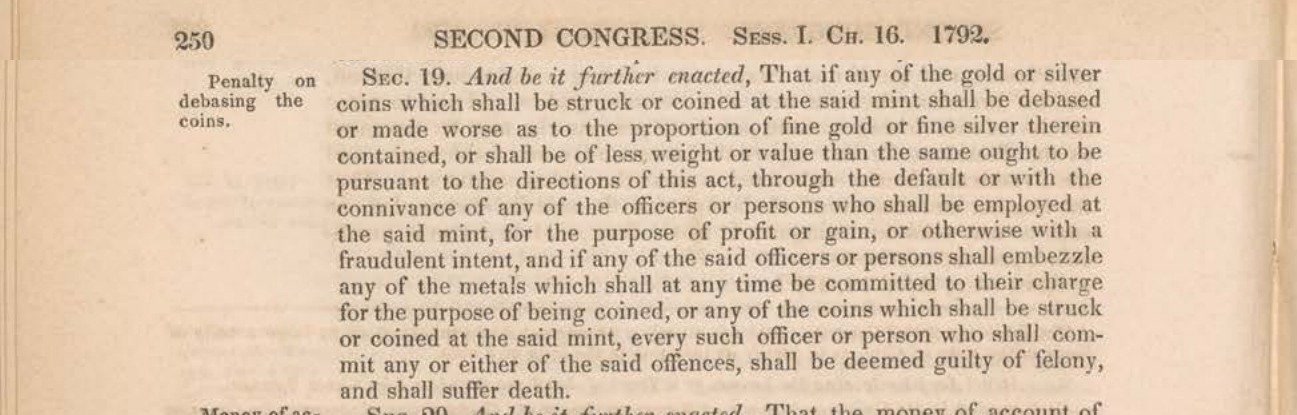
Section 19 said that if any officer or employee of the Mint debased the gold or silver coins "with a fraudulent intent," or embezzled the metal entrusted to them for coining, they "shall be deemed guilty of felony, and shall suffer death."
The persons named are an officer or an employee of the Mint. The acts named are debasing the gold or silver coins, and embezzling the metal entrusted for coining. The intent named is fraudulent. The penalty named is felony, and death. The page in the picture is Section 19 as printed in the U.S. Statutes at Large, volume 1, page 250.
The small brick mint
Think about what that meant for the workers at the small brick mint in Philadelphia. The silver that passed through their hands belonged to the public. Shaving a little from each coin was the very trick that had hollowed out Rome's money. In the new republic it could cost a man his life.
Small and brick is how the article describes that mint. The silver belonged to the public. Shaving a little from each coin is the trick just named in Rome. Cost a man his life is the penalty, applied to a Mint worker who did it with fraudulent intent. The picture is the mint in Philadelphia, colorized.
Ninety percent, for a long time
For most of the next 170 years, American dimes, quarters, and half dollars stayed silver coins. From 1837 on, the standard was 90 percent silver, 10 percent copper.
Most of the next 170 years is the span the article gives after 1792. Dimes, quarters, and half dollars are the coins named. From 1837, the standard is 90 percent silver and 10 percent copper.
23 July 1965
Then, in the early 1960s, the market price of silver rose toward the point where the metal in a coin was worth almost as much as the coin itself. People began holding on to silver coins, and change grew scarce in shops and banks. On 23 July 1965, President Lyndon B. Johnson signed the Coinage Act of 1965.
The early 1960s are when the article places the rise in the market price of silver. Almost as much as the coin itself is how close that metal value came. Holding on to the coins is what people did, and change grew scarce in shops and banks. 23 July 1965 is the day Johnson signed the new act.
Silver left the dime and the quarter entirely. In its place came clad coins. Clad means layered, like a sandwich: two outer layers of copper-nickel bonded to a core of pure copper. Look at the edge of a quarter today and you can still see the copper stripe. The half dollar kept some silver for a while. From 1965 to 1970 it was 40 percent silver, and after that it went clad as well.
Left entirely means the dime and the quarter. Clad is the sandwich: copper-nickel, pure copper, copper-nickel. The copper stripe is the edge you can still see. The half dollar is the exception in the article: 40 percent silver from 1965 to 1970, and clad after that. The card with that act shows the layered coin and the date.
No one was charged
No Mint officer went to the gallows over it. Nobody was charged at all. Section 19 had been written to stop a worker who stole metal from the public with a fraudulent intent. In 1965 the change came from Congress, out in the open, and it was signed into law.
The gallows is the death penalty in Section 19. Nobody charged is the article's statement about 1965. The distinction it draws is the one in the statute: a worker, fraudulent intent, metal stolen from the public, against a change Congress made in the open and signed into law.
Same face, less silver
The old silver dimes and quarters slowly disappeared from circulation and into drawers, jars, and collections. The new coins kept the same faces, the same sizes, and the same names. A dime still said ONE DIME.
Drawers, jars, and collections are where the article says the old silver coins went. Same faces, same sizes, same names are what the new coins kept. ONE DIME is the legend the article quotes.
Rome's coins kept the emperor's face long after the silver was gone. America's quarter kept Washington's.
The emperor's face is the Roman half of that last comparison. Washington's face is the American half. The silver was already gone from the metal.
The dates in order
Rome's silver, the 1792 penalty, and the statute that took the silver out.
- Under Augustus. A denarius is about 95 to 98 percent pure silver.
- Around 270 AD. The antoninianus has pushed the denarius aside. Under Gallienus and Claudius II it holds about 5 percent silver or less. Many pieces are bronze with a silver wash.
- About three centuries. The coin goes from almost pure silver to mostly copper, one batch at a time, with no law announcing it.
- Spring 1792. The Coinage Act defines the dollar by a fixed weight of silver. Section 19 makes fraudulent debasing, or embezzling the metal, a felony punished by death.
- 1837. The standard for the silver coin becomes 90 percent silver and 10 percent copper.
- Early 1960s. The market price of silver rises toward the metal value of the coin. People hold silver coins. Change grows scarce.
- 23 July 1965. Johnson signs the Coinage Act of 1965. Silver leaves the dime and the quarter. Clad coins replace them. The half dollar is 40 percent silver through 1970, then clad.
- After that. No Mint officer is charged. The old silver coins leave circulation for drawers, jars, and collections. A dime still says ONE DIME.
Close
Section 19 pointed at a worker who cheated the metal in his hands. The later change pointed at a statute everyone could read. The faces on the coins stayed. The silver did not.
A shorter version of this note first appeared as an X Article.