
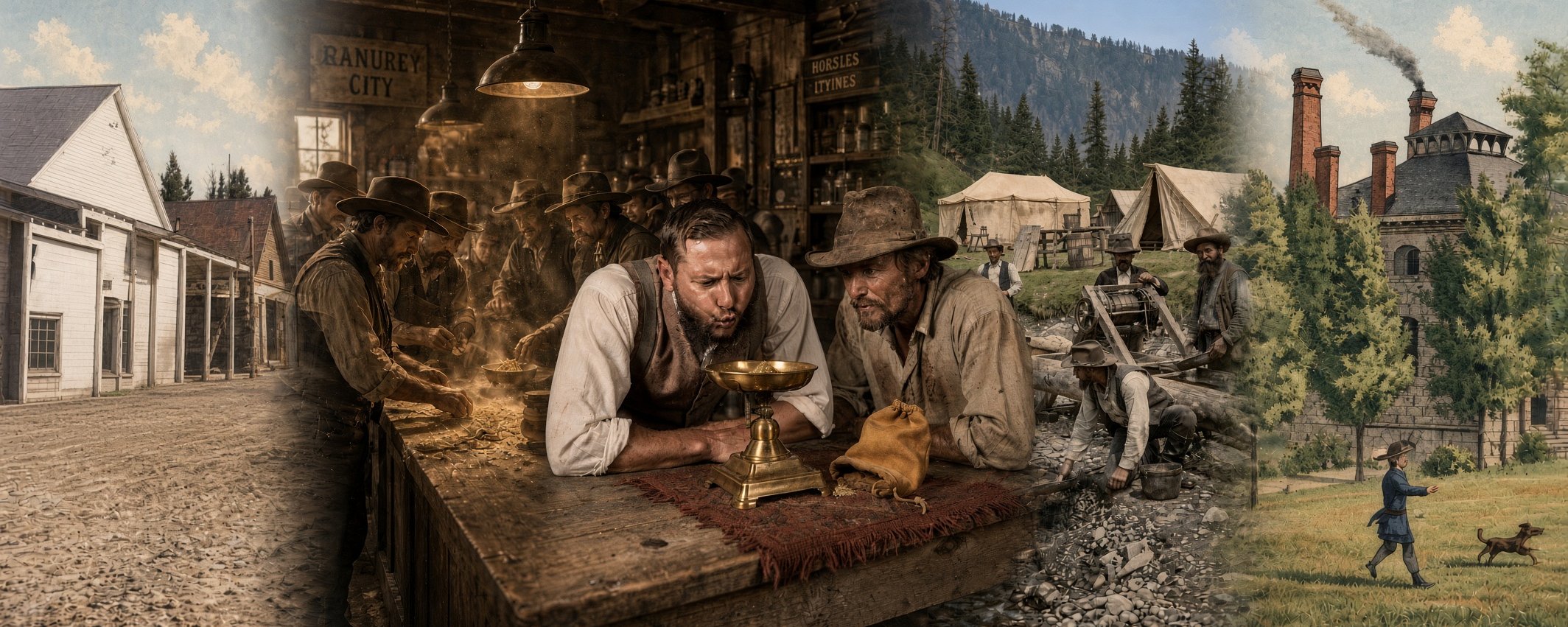
On 7 October 1862, a party of miners laid out a town beside a creek in the mountains of what is now southern Idaho. They called it Bannock City. Within about a year it had more people than Portland, Oregon, and most of them paid for their flour, boots, and whiskey with a pinch of gold.
Laid out means the streets and lots were marked. The creek is not named. The payment is the fact that matters: a pinch of gold, not a paper note and not a minted coin, settled the bill for flour, boots, and whiskey.
The gravel, two months earlier
The gold had turned up two months earlier. On 2 August, prospectors led by George Grimes and Moses Splawn found rich gravel in the Boise Basin, a bowl of forested hills northeast of today's city of Boise. Grimes was killed in the hills within days. The others carried their gold back to Walla Walla, in Washington Territory, and that fall they returned with a much bigger party.
Rich gravel means loose gold already in the creek beds. Walla Walla is where they carried the news, and the bigger party is the one that came back that fall.
A week of prospecting, then a town
The newcomers did well. A week of prospecting brought in $2,000, and most men could count on $8 to $20 a day. On 7 October, J. Marion More, one of the discovery party, founded the town.
The $2,000 is one week's take for the party. The $8 to $20 is what most men could count on in a day. More is named as one of the discovery party.
Winter, flour sacks, and rockers
By December a full rush was on, and winter did not stop it. Men packed gravel in flour sacks down to whatever water still ran and washed it in rockers, wooden boxes rocked like a cradle so the heavy gold settled out. By the end of January 1863, some 4,000 miners were in the basin.
A rocker is that wooden box. Rock it, and the heavy gold stays while lighter sand washes on. Flour sacks are how they carried the gravel to water that had not frozen. Some 4,000 is the count given for the end of January. The picture with that winter is an illustration of men at rockers beside a half-frozen creek. The article marks it as an illustration, not a photograph from 1862.
Idaho City, and a larger town than Portland
In March 1863 Congress created Idaho Territory, and that December the town was renamed Idaho City, so it would stop being confused with Bannack, another gold camp in what is now Montana. By then more than 6,000 people lived there. Idaho City had passed Portland as the largest community in the Pacific Northwest.
March is the territory. December 1863 is the new name. Bannack, spelled with an a, is the other camp. Bannock City, with an o, is this one. More than 6,000 is the count the account gives for the renamed town, and that count is what put it ahead of Portland. The street in the picture is Main Street around 1920, long after the rush had faded.
Gold dust, not greenbacks
What they mined was placer gold: loose flakes and grains that streams had worn out of the rock and buried in their gravel. Washed and dried, it was called gold dust, and in Idaho City the dust was the money.
The paper "greenbacks" the Union had begun printing in 1862 to pay for the Civil War were trusted less than gold. So every banker, storekeeper, and saloon kept a small brass balance on the counter, and customers carried their dust in buckskin pouches closed with a drawstring. Thomas Donaldson, who came to Boise as a federal land officer in 1869, described how a purchase went. The greenbacks and the Civil War are that paper.
Placer gold is the loose metal in the gravel, not a vein. Washed and dried, it is dust. A balance is a small scale. A drawstring pouch is how a customer carried it. Donaldson is a witness from 1869, a federal land officer in Boise, writing about a counter that was already the town's habit.
Blow on the pan
"The buyer or weigher turned the dust into the pans of the scales and then blew smartly on the mass to weed out all valueless light stuff."
Dishonest weighers, he added, blew harder than they needed to, so bits of the seller's gold scattered off the pan. The scales usually sat on a scrap of carpet. Donaldson saw one strip, about fifteen inches square, give up nearly $100 in gold that had fallen or blown off the pans in a single year.
The blow is the step that separates dust from grit. A harder blow is the cheat: gold leaves the pan with the grit. The carpet is where that gold landed. Fifteen inches square, and nearly $100 in one year, is the strip Donaldson saw. The illustration with the scales shows dust on a brass pan at a store counter. The article marks that picture as an illustration.
The same counter, a generation later
The next picture is not Idaho City. It is a store counter in Dawson, Yukon, in 1899. A customer's dust goes onto a brass scale. The article's point is that Idaho City's counters had worked the same way a generation earlier.
Dawson is the later camp. 1899 is a generation after 1862. The photograph is by Larss and Duclos. The comparison is the article's: same gesture, dust onto a brass scale, on a counter.
Less than the mint's price for pure gold
Dust was never worth the full price of gold. The U.S. Mint paid $20.67 for an ounce of pure gold, but creek gold came mixed with silver and grit. Donaldson recalled that dust was accepted at $16 an ounce, and the silvery dust from the Owyhee mines to the southwest at only $10. Greenbacks were taken at 75 to 80 cents on the dollar against gold coin, and from 1863 to 1868 territorial taxes were collected in gold coin or its equivalent.
$20.67 is pure gold at the mint. $16 is this creek dust, and $10 is the silvery Owyhee dust to the southwest. A greenback dollar was taken as less than a gold-coin dollar.
Bogus dust
A money you weigh invites cheating. Crooks stretched their dust with particles of iron and lead, and fake dust was common enough to get its own name: "bogus." Local legend says Bogus Basin, in the hills above Boise, is named for a gang of counterfeiters who worked there. Merchants answered by raising their prices.
Iron and lead are the metals the account names in the stretched dust. "Bogus" is the name it gives that fake dust. The basin's name is given as local legend, not as a record that has been proved, and this note keeps it as legend. Raising prices is how merchants answered a money they weighed by hand.
Ditches, a nozzle, and fires after dark
None of it slowed the digging. Miners dug some eighty miles of ditches to bring water to their claims, and near town a hydraulic giant, a big metal nozzle that blasted gravel banks apart with water from a high ditch, was already at work. In the spring of 1864, five or six hundred new miners arrived every week. Crews worked day and night while the snowmelt lasted, and from Idaho City you could see more than thirty fires burning on the claims after dark.
Eighty miles is the ditch figure. A hydraulic giant is the nozzle. The water comes from a high ditch, so the force is the height of that ditch. Five or six hundred new miners a week is the spring of 1864. More than thirty fires is what you could see from town after dark, while the snowmelt lasted. The photograph of water jets is Idaho City around 1920, the same kind of work, years after that first spring.
An assay office in Boise
Every ounce still had to be valued somewhere, and for years the dust went out by express and steamer to the mint in San Francisco. In 1869 Congress voted $75,000 for a federal assay office in Boise, where the government melted miners' gold, tested how pure it was, and put an honest value on it. It opened in 1872.
Express and steamer is the route to San Francisco before Boise had its own office. $75,000 is the sum Congress voted in 1869. An assay office melts the gold and tests how pure it is. The office opened in 1872. The picture is an 1884 lithograph of that building on Main Street in Boise.
The easy gold, and the first winter
By then the easy gold in the creeks was mostly gone. But in that first winter after 7 October 1862, the town's wealth moved around in buckskin bags, and every purchase ended the same way: a little pile of gold on a brass pan, and someone leaning in to blow.
"By then" is 1872, when the assay office opened. The first winter is the one after the town was laid out: buckskin bags, a brass pan, and someone leaning in to blow.
The dates in order
The find, the town, the dust on the counter, and the office that came later.
- 2 August 1862. Grimes and Splawn find rich gravel in the Boise Basin. Grimes is killed in the hills within days. The others carry the gold to Walla Walla.
- 7 October 1862. The party lays out Bannock City. J. Marion More, of the discovery party, founds the town. A week of prospecting had brought in $2,000. Most men could count on $8 to $20 a day.
- December 1862. A full rush is on. Men wash gravel in rockers wherever water still runs.
- End of January 1863. Some 4,000 miners are in the basin.
- March 1863. Congress creates Idaho Territory.
- December 1863. The town is renamed Idaho City, so it will not be confused with Bannack. More than 6,000 people live there. It has passed Portland.
- 1863 to 1868. Territorial taxes are collected in gold coin or its equivalent. Greenbacks are taken at 75 to 80 cents on the dollar against gold coin.
- 1869. Donaldson is in Boise as a federal land officer, and he describes the scales, the blow, and a carpet that gave up nearly $100 in a year. The same year, Congress votes $75,000 for an assay office in Boise.
- Spring 1864. Five or six hundred new miners arrive every week. Some eighty miles of ditches are in use, and a hydraulic giant is already at work near town.
- 1872. The assay office opens. The easy gold in the creeks is mostly gone.
Close
For that first winter the money was the dust itself. You carried it in a pouch, someone else weighed it, and a breath decided how much grit left the pan.
A shorter version of this note first appeared as an X Article.