
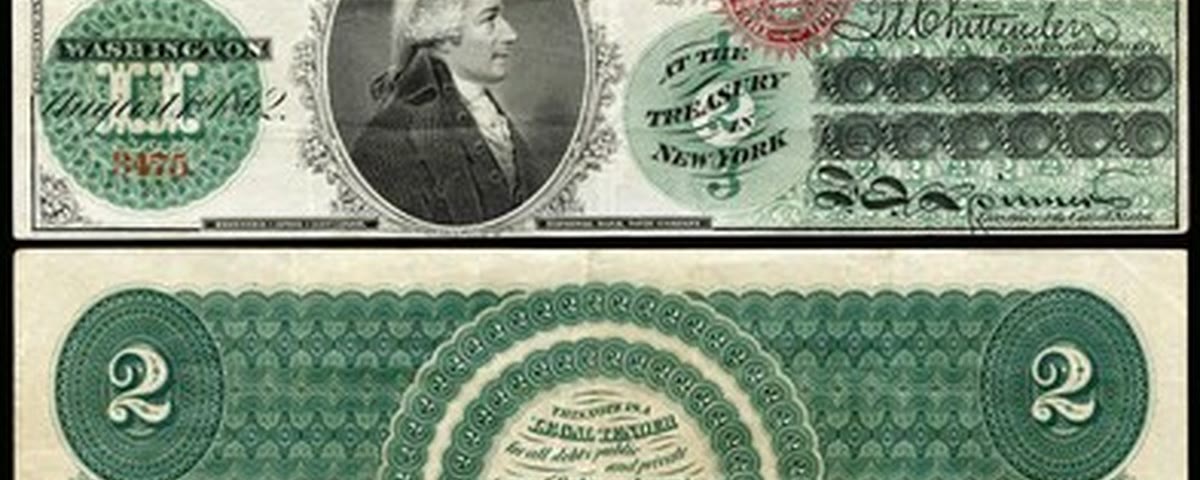
In February 1862, Congress made United States Notes — greenbacks — legal tender for most debts, because the banks had already stopped paying gold and silver at the end of 1861 and the Treasury still had a war to finance. Gold kept its own price for customs duties and for foreign exchange. In New York a market quoted how many greenbacks it took to buy one gold dollar, and that premium widened whenever Union fortunes looked dark.
The notes suspended the metallic dollar for the duration of the fighting, which is not the same as claiming that paper had replaced metal for good. After Appomattox the argument moved to whether the stock of notes should shrink, whether gold payments should return, and at what parity. The Specie Payment Resumption Act of 1875 named the morning: 1 January 1879. Between the Legal Tender Act and that date lay seventeen years of war, politics, and a Treasury gathering gold.
Why the Union issued greenbacks
War spending outran what taxes and bonds could raise, so the Treasury needed a currency the public and its contractors would take when gold coin had left everyday Union payments. Congress authorized United States Notes — demand notes at first, then the familiar green-backed legal-tender notes.
Legal tender meant a creditor had to accept the notes for most public and private debts, though customs duties and the interest on some bonds stayed closer to gold. The notes were obligations of the United States, not warehouse receipts for a named pile of coin, and convertibility into gold stayed suspended for the emergency.
The Confederacy printed its own flood of paper, and that issue died with the regime. The Union’s greenback survived the war and then set the terms of peacetime politics, because every mortgage and bond written in paper was now a bet on whether the notes would ever meet gold again.
Gold premium and the New York gold room
Once greenbacks were legal tender while gold remained the metal of customs and of foreign bills, two prices appeared, and goods quoted in “currency” (paper) pulled away from prices in gold. In New York a gold market — informal, then more organized — posted the gold premium of coin over greenbacks.
When Union fortunes looked dark, the premium widened, because more greenbacks were needed to buy a gold dollar, and when military and fiscal news improved, the premium narrowed. Importers who needed gold for duties watched that market daily. The worst of it came in the summer of 1864, with Grant stalled before Petersburg and Confederate raiders near Washington: it took roughly $2.85 in greenbacks to buy one gold dollar.
The premium is the record that greenbacks were not “as good as gold” during the war. They were a forced paper unit beside a gold unit that still priced customs and foreign exchange. Wage earners felt it as lost purchasing power: the same paper dollar bought less of anything tied to gold or imports, and wages were slow to catch up.
Legal tender cases and postwar politics
After the war, debtors liked paying in cheaper paper while creditors wanted gold or a smaller note issue, and the Supreme Court’s Legal Tender Cases flipped before they settled. *Hepburn v. Griswold* (1870) held the notes could not be forced on creditors for debts contracted before the Act. A year later, with two new justices on the bench, *Knox v. Lee* reversed that. *Juilliard v. Greenman* (1884) extended the power to peacetime.
Politics split along familiar lines. “Hard money” voices wanted a rapid return to specie and a smaller greenback stock, while the Greenback Party and agrarian voices wanted more paper, or at least no contraction that would raise the real burden of debts. Bondholders who had lent in gold terms watched every Treasury signal.
National banking acts during and after the war created a federal note framework beside the greenback. The two paper stocks were not the same instrument: bank notes under national charter, United States Notes as direct Treasury obligations. Public argument often mashed them into one “paper money” complaint. The split mattered when resumption came: it was the Treasury’s own notes that had to be redeemed.
The greenback was no longer only a war tool. It was a peacetime unit whose quantity and convertibility would decide winners and losers on every farm mortgage and railroad bond.
Resumption Act of 1875
The Specie Payment Resumption Act committed the Treasury to redeem United States Notes in coin on and after 1 January 1879. The Act also allowed gradual reduction of the greenback circulation toward a floor of $300 million, and it authorized gold accumulation to make the promise credible.
Resumption did not happen overnight in 1865. It took a decade of politics, surplus fiscal conditions in some years, and a Treasury that actually built a gold reserve. John Sherman, Treasury secretary from 1877, sold bonds for gold to fill it. Opponents tried to repeal or soften the commitment. In 1878 Congress stopped further retirement of greenbacks with about $347 million still outstanding — but the date held. When the day came, greenbacks traded at par with gold; the wartime premium was gone. The paper note became again a claim on coin at a one-to-one practical rate.
Full legal definition of the dollar as a gold unit waited until the Gold Standard Act of 1900. Resumption restored the practice; the 1900 statute wrote the definition. Between them sat the silver fight that began with the Coinage Act of 1873.
A short timeline
From the day the banks stopped paying metal to the morning the premium closed.
- December 1861: Banks suspend specie payments.
- February 1862: Legal Tender Act — United States Notes (greenbacks) authorized as legal tender.
- 1862–65: Gold premium fluctuates with war news; greenbacks finance a large share of Union spending.
- 1865–75: Postwar fight over contraction versus more paper; Legal Tender Cases in the courts.
- January 1875: Specie Payment Resumption Act; redemption date set for 1 January 1879.
- 1 January 1879: Specie payments resume; greenbacks at par with gold in practice.
War paper, then a dated return
The Union paid for much of its war in a note that promised no metal on any date. The gold room in New York priced that promise every day, and the price moved with the battle news. When peace came, the notes did not disappear. They became the ordinary money of farm mortgages and railroad bonds, and every question about their quantity was a question about who owed whom.
Congress answered with a date rather than an open-ended promise. It named 1 January 1879, let the Treasury gather gold, and held to the day while the arguments continued. On that morning a greenback was worth a gold dollar again.