
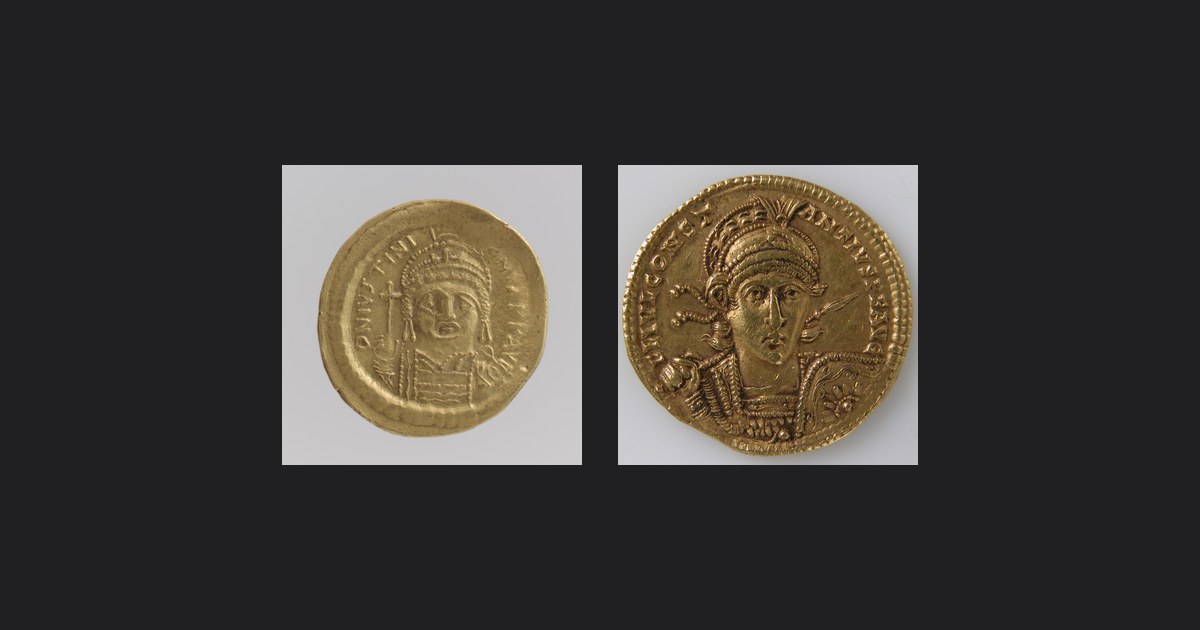
In the early fourth century, Constantine’s mints settled on a gold coin of tightly held weight and fineness — about 1/72 of a Roman pound, roughly 4.5 grams — and that solidus became the premier gold unit of the late Roman world. It outlasted the western empire and lived on in Constantinople as the nomisma. What made it famous was not its beauty. It was that the weight stayed put.
The timing mattered. By the worst years of the third century, many coins that still passed as silver were bronze underneath, a wash over a familiar face, while pay tables and tax assessments still needed a piece strangers would trust overnight. Gold already covered large payments, so Constantine’s solidus made that order explicit and durable.
What Constantine changed
In the 310s the solidus stuck as the empire’s premier gold unit. The tetrarchs before Constantine had experimented with gold, and his coin is the one that held, so accounts, taxes, and payments to the elite could name a piece whose metal content people trusted. Bronze and reformed base coins still handled small change under other names.
The work came during imperial consolidation after civil war, when a state that collected and spent across an enormous territory needed a gold unit that did not have to be re-assayed every time a bag crossed a desk. Pay tables that could name a reliable gold piece cut through the confusion left by silver coins that no longer meant what their designs claimed.
That practical usefulness is why the solidus outlived slogans of restoration. It became the reference gold coin for centuries — not because a decree said so forever, but because the metal in the hand stayed close to what the type promised.
A known weight of gold
What set the solidus apart was not a handsome type. It was discipline about mass and purity, so a merchant or a tax official could treat the coin as a known quantity of gold — the same logic as an early mint stamp, only now the promise was a gold weight held for generations.
The pressure to debase never disappears in a state that needs money. The solidus is remembered because, for long periods, authorities treated its standard as something to defend, and later debasements and reforms were measured against the memory of that hard gold piece.
Silver and base coins could still be adjusted for local pay, while the solidus had a different job: the large, trusted settlement piece people reached for after silver’s reputation had burned. Everyday markets still needed small change. Large contracts and fiscal accounts needed something that held.
Fractions — the semissis, the tremissis, and later related issues — let gold work at more than one size of payment without abandoning the fixed weight. The full solidus stayed the reference, and a half or a third was still a slice of the same standard rather than a new promise invented for convenience.
From Rome to Byzantium: the nomisma
As imperial power centered on Constantinople, the solidus continued in Greek as the nomisma, with related denominations. Western kingdoms minted their own gold at times, often imitating familiar types, while the eastern empire kept the solidus alive as a working standard for Mediterranean and Near Eastern trade.
Foreigners gave good Byzantine gold names that signaled trust, and the medieval “bezant” of western sources is that reputation traveling. Across changing dynasties the coin’s weight stayed credible enough to price contracts and tribute, so a merchant who had never seen the emperor still knew what a solidus-weight of gold looked like in the balance.
Byzantine finances were not frozen. The empire had its own crises, reforms, and later lightenings, and even so, for a long stretch, the solidus and its heirs kept their metal. The unit could outlast a capital because the scales, rather than the slogans, were what people trusted.
Trade routes still needed a settlement metal strangers would accept overnight, and for centuries the nomisma filled that role because the mint’s promise stayed close to the metal in the hand.
How long a gold weight can last
A lasting gold weight does not mean Rome never fell. The collapse of the west and the survival of the east are separate facts from the mint’s scales, and a gold standard can outlast a capital. This one outlasted western Rome by the better part of a thousand years.
Clipping and debasement fail on the scale; washed silver had taught everyone to look. The solidus’s reputation rested on how often that check still matched the type. A coin you hold is honest — or not — by metal and mass. That is the whole test.
Later Europe would invent different instruments: warehouse receipts, deposit banks, banknotes — claims on metal kept elsewhere. Those are other machines. The solidus is simpler. Its promise is the gold in the hand.
A short timeline
- Early 4th century: Constantine establishes the solidus as the premier gold unit, about 1/72 of a pound.
- 4th–5th centuries: The gold solidus frames elite and fiscal payments while the memory of third-century silver lingers.
- Byzantine centuries: The nomisma carries the weight forward; western traders call good eastern gold the bezant.
Where the weight held
Third-century silver had been thinned until a wash stood where a denarius had been, and Constantine answered with gold of fixed weight. That weight held for longer than the western empire itself. A solidus is a coin you hold. Its honesty is metal and mass.
Anyone curious about how Rome’s everyday silver got there can read Rome: denarius and aureus. The solidus itself needs no sequel: for centuries, the type and the gold stayed close enough that strangers could settle on the scales.