
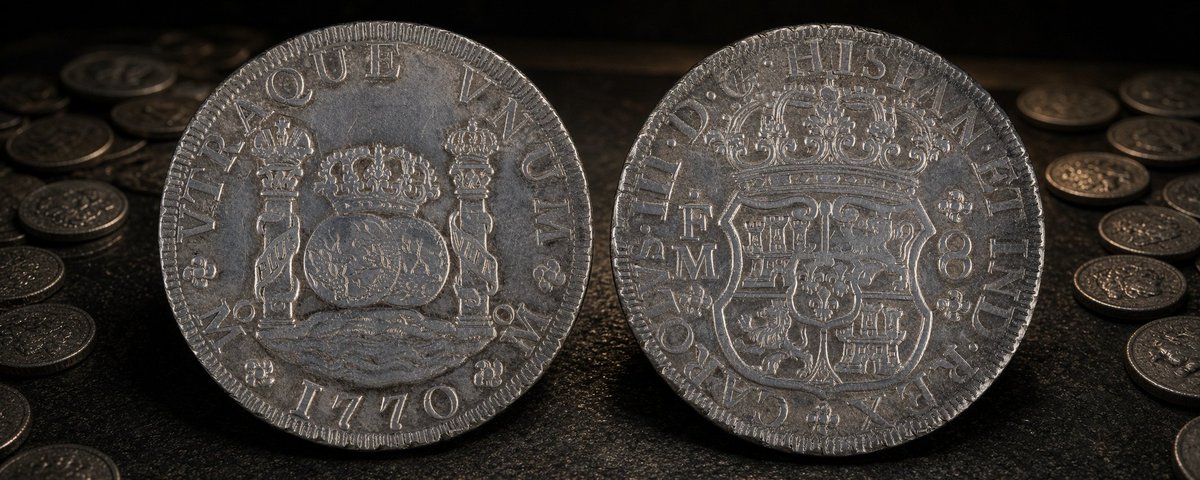
A silver dollar in an American pocket did not have to be American. For decades after the Revolution it was often Spanish, or Mexican and struck to the same idea. People called it a piece of eight. That was the coin, not a nickname for something else. Eight reales of silver made the dollar.
Cut one, and the pieces had names a shopkeeper used. One real was an eighth of the dollar, twelve and a half cents, a bit. Two reales were a quarter, two bits. A half real was a sixteenth, six and a quarter cents. The stamp was foreign. The names were the ones a till already knew.
Legal tender is narrower than a coin that passes. For a long time the United States treated this silver as money the law would recognize. This note is the day that recognition ended, and the smaller rates the offices used on the way out.
The dollar, named in Spanish silver
On 8 August 1786, Congress adopted the dollar as the money unit of the United States and rooted it in that Spanish silver. The resolve fixed the dollar at 375 grains and 64 hundredths of a grain of fine silver. Fine silver is the pure metal inside the weight, not the whole coin with its alloy. The unit the United States chose already had a weight people could hold.
That date is the start of the American name, not the start of the coin. The silver was already in pockets. Congress pointed at it and said this weight is the dollar. The card set into the short piece marks the same day. What this note follows is that 1786 line.
A coin that was already old
The piece of eight was already old. Mexico City struck it with two crowns and the sea between them, and on the other side the arms of Spain with an 8 beside the shield. A dollar of 1770 from that mint still reads. The date is under the waves. The 8 is by the shield. That 8 is the eight reales. A coin of that year was already old when Congress named the dollar, and people could still pass it.
The first American dollar, sized on the Spanish one
The first dollar coin the United States issued was sized on this Spanish coin. It was the Flowing Hair dollar, minted in 1794 and 1795. Its size and its weight followed the Spanish dollar. The American piece was new. The measure it followed was not.
A weight written down in 1792
On 2 April 1792, Congress had already defined that dollar as 371 and a quarter grains of pure silver, inside a coin of 416 grains. The number came from Spanish dollars then passing from hand to hand. Pure silver is the fine metal. The larger number is the coin as struck, alloy included, so the piece would hold together. The statute did not invent a new weight from a blank page. It measured coins that were already moving.
A United States silver dollar dated 1843 shows Liberty seated, the date under her, and an eagle on the back with the words ONE DOL. The piece shown is a proof of that design — a carefully struck example of the type, not a shop price.
1786 and 1792 are not the same sentence. The first fixed the dollar at 375 grains and 64 hundredths of a grain of fine silver. The second defined it as 371 and a quarter grains of pure silver, inside a coin of 416 grains. Both come from Spanish silver then passing from hand to hand.
Foreign coin, written in as money
On 9 February 1793, foreign gold and silver coins became legal tender at rates written into the statute. A Spanish milled dollar passed at one hundred cents if it still weighed at least seventeen pennyweights and seven grains, which is 415 grains. Its parts passed in proportion. A creditor who was offered that coin, at that weight, was being offered something the law called a dollar.
Other foreign silver was on a clock. Three years after the mint began striking gold and silver, foreign gold coins, and foreign silver other than Spanish milled dollars and their parts, would cease to be legal tender. The Spanish dollar was the coin the law kept. One dated 1821 shows a king's head and an 8 for the eight reales.
Still on the books in 1843
It stayed on the books. On 3 March 1843, Congress again set the currency of foreign gold and silver coins. The Mint's report the next year said the Spanish dollar of that older design, and the dollars of Mexico, Peru, and Bolivia, were current at one dollar if they were at least 897 thousandths fine and at least 415 grains. 897 thousandths is the share of silver in the alloy: 897 parts in a thousand. A light coin, or a coin that was not that fine, was not the dollar the report described.
A dollar of the Mexican republic showed an eagle on a cactus and the name of the republic. The stamp is not the king's head of 1821, and it is not the Mexico City piece of 1770. The report still put it with the dollars of Peru and Bolivia when the fineness and the weight were there.
Wear had lightened the small pieces. A two-reales coin was still the fourth of the dollar. At the government offices and the banks, the worn fractions were already being refused at those old names. A coin that had lost silver in a pocket was no longer the fraction a shop had been using. That refusal was already happening before Congress closed the book.
21 February 1857
On 21 February 1857, the arrangement ended. That day's Coinage Act repealed every former act authorizing the currency of foreign gold or silver coins and declaring them a legal tender for debts. Spanish and Mexican silver dollars, pieces of eight, lost that standing with every other foreign gold or silver coin.
The earlier statutes had said these coins were current, at stated weights and rates. The act of this day took those authorizations off the books. Foreign gold and foreign silver were in the same sentence. The Spanish and Mexican dollars did not keep the exception they had held since 1793.
What the offices could still take
The act still named what the offices could take in. At the Treasury and its offices, and at the post offices and the land offices, the fourth of a Spanish dollar or of a Mexican dollar, the piece of two reales, was receivable at twenty cents. The eighth, one real, at ten cents. The sixteenth, a half real, at five cents.
Twenty was not twenty-five. Ten was not twelve and a half. Five was not six and a quarter. The old names were the cut of a dollar: a quarter, an eighth, a sixteenth. The rates the offices could use on the way out were lower. A two-reales piece that a shop had called a quarter was receivable at those offices at twenty cents. The eighth came in at ten, not at a bit. The sixteenth came in at five, not at six and a quarter.
Once received, those coins were not to be paid out again. They were to be recoined at the mint. Taking them in was not the same as leaving them in circulation. The old stamp was not supposed to go back out over the counter.
Two years at the old names, in cents
For two years from the passage of the act, and no longer, the mint could pay out its new cents for those same pieces at the old names: twenty-five cents, twelve and a half, and six and a quarter. Then that rate closed. The cents were the new small ones. An 1858 Flying Eagle cent, dated inside that window, is the coin the mint could hand back. That mint window is not the office rate. The offices took the fractions at twenty, ten, and five, and did not pay the coins out again. The mint, for two years only, could hand back cents at the old names.
The statute set no such price on the whole piece of eight. A foreign gold or silver coin was no longer legal tender for a debt. The fractions had a temporary rate. The whole dollar did not.
The dates in order
The silver was named, kept, and then released.
- 8 August 1786. Congress adopts the dollar and roots it in Spanish silver, at 375 grains and 64 hundredths of a grain of fine silver.
- 1770. A Mexico City dollar of that year still shows the date under the waves and an 8 by the shield.
- 2 April 1792. The dollar is 371 and a quarter grains of pure silver, inside a coin of 416 grains.
- 1794 and 1795. The Flowing Hair dollar is the first dollar coin the United States issues, sized on the Spanish dollar.
- 9 February 1793. Foreign gold and silver become legal tender at statutory rates. A Spanish milled dollar of at least 415 grains passes at one hundred cents. It is the foreign silver coin the law keeps.
- 3 March 1843. Congress sets foreign gold and silver again. The next year's Mint report holds the older Spanish dollar, and the dollars of Mexico, Peru, and Bolivia, current at one dollar if they are at least 897 thousandths fine and at least 415 grains.
- 21 February 1857. The Coinage Act repeals legal tender for foreign gold and silver coins. Offices may take the fractions at twenty, ten, and five cents, and may not pay them out again. For two years the mint may pay new cents at the old names.
Close
A shopkeeper could still be handed a Spanish dollar or a Mexican one. He did not have to take it as money. On 21 February 1857, Congress stopped calling it legal tender.
Eight reales were still eight reales. What changed was the duty. A creditor no longer had to take the Spanish or Mexican dollar. The small pieces could still be turned in, at the rates the act wrote down, and then recoined. The whole piece of eight had no such price.
A shorter version of this note first appeared as an X Article.