
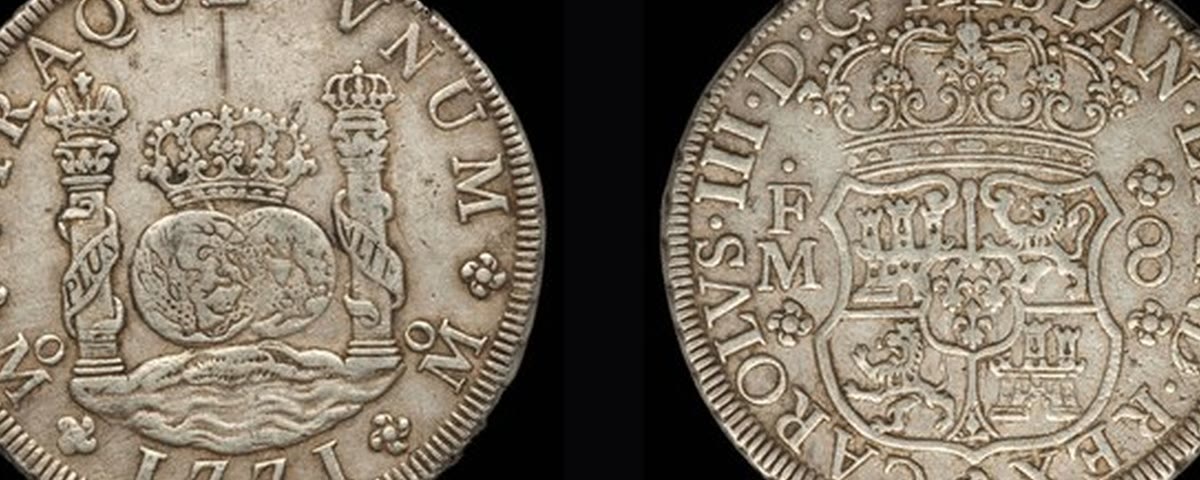
For more than two centuries, merchants across the Atlantic and the Pacific priced cargo in one familiar silver coin: the Spanish dollar — the eight-real piece, the piece of eight. Sailors cut it into bits when they needed change, and Asian markets took the whole coin as settlement metal. When the young United States named its own dollar in the 1790s, this piece was already the one Americans carried.
A silver coin of roughly twenty-seven grams had become a world unit of account long before any modern reserve currency, and much of its metal came out of one mountain, Potosí. The name and the weight went on into early U.S. coinage.
Eight reales, one recognisable weight
Spanish colonial mints struck the real de a ocho — eight reales — as a large silver coin of roughly 27 grams, about 0.87 troy ounces of fine silver on the familiar later reckoning, with variation by mint and by wear. It carried the arms of the Habsburg or Bourbon kings, a mint mark, and a date, and pieces from Mexico City, Potosí, Lima, and other American mints went out into Atlantic and Pacific trade.
“Piece of eight” is the English name, and “Spanish dollar” is the commercial name that stuck in North America and the Caribbean. Neither name describes a new metal. Both name a familiar weight of silver that strangers could recognise without a letter of credit from a local prince.
Cut pieces — bits of eight — were everyday arithmetic, and two bits made a quarter dollar, as later American slang still remembers. The whole coin stayed the large settlement piece. It was divisible in the hand, not only on paper, which is why it traveled well.
From American mints to world ports
Colonial silver did not stay in the Andes or in New Spain. It went onto the fleets, to Seville and Cádiz, and into European payments, and across the Pacific the Manila galleon carried it toward China and the wider Asian silver market. Ports that never saw Cerro Rico still received its metal as coin.
In the Caribbean and British North America, where local coin was scarce, Spanish dollars were ordinary money, so contracts, wages, and taxes often meant that coin when they said “dollar.” In East Asia, after earlier paper experiments had failed or been abandoned, trade absorbed Spanish silver as settlement metal. A coin from a Spanish American mint could close a deal in Canton or Manila because both the metal and the design were known.
There were rivals — Dutch and Portuguese coins, and later British trade dollars — and the Spanish piece won on volume and on familiarity. Money has network effects: the coin you can spend tomorrow is the coin you accept today.
Why one silver coin travelled
A world coin is not a metaphor. It is a repeated claim about weight and fineness that markets actually use, and the piece of eight held because three things were true together. Spanish American mines supplied silver at imperial scale, colonial and home mints stamped a design people recognised, and the trade routes already priced goods in that coin.
Trust still mattered. Clipped, plugged, and counterfeit pieces sent people back to scales and assays, so familiarity lowered the cost of checking without ending the check. When a mint lightened the coin or a buyer doubted it, discounting returned, and Gresham’s pattern with it. For generations, though, the claim held across oceans.
Athens’ owl had been a silver network at Mediterranean scale. The piece of eight was the same idea stretched around the planet — a different century, and a far larger volume of metal.
The United States inherits the habit
The Coinage Act of 1792 defined an American silver dollar whose weight sat close to the Spanish coin Americans already used, because Hamilton and Congress did not invent the dollar from nothing. They wrote a law around a commercial habit, and set gold beside silver at a fixed mint ratio — the start of American bimetallism.
The United States took over a unit traders understood, then spent the next century fighting over whether gold, silver, or paper would rule it. The piece of eight is the coin the republic inherited, and the Crime of 1873 was a later fight over what the law would still count as a dollar.
Spanish dollars kept circulating in the United States for decades after independence, because laws and mint output took time to replace a coin the whole Atlantic already knew. Foreign silver stayed legal tender in the United States until 1857.
A short timeline
The coin settled an empire’s trade for generations before national coinages finished replacing it.
- 1490s–1500s: Spanish conquest and early colonial mining; silver begins to enter Atlantic payments.
- 1540s onward: Potosí and other American mines feed colonial mints; eight-real pieces become the empire’s coin.
- 1565–1815: The Manila galleon links Acapulco silver to Asian demand for settlement metal.
- 17th–18th centuries: Spanish dollars are common money in the Caribbean and British North America.
- 1792: The U.S. Coinage Act defines a dollar near the Spanish silver weight, with gold beside silver at a mint ratio.
- 19th century: National coinages and gold standards gradually displace the Spanish dollar as an everyday unit.
One coin, several later fights
The Spanish dollar faded as national mints and gold standards took over. The fights it left behind did not. The mountain that fed so much of its metal is Potosí, the American dollar that copied its weight is early U.S. coinage, and the problem of keeping two metals in one money is bimetallism.
Those threads run through the rest of silver in history — from Potosí and the Spanish dollar through the mint-ratio fights, Silver Thursday, and silver’s industrial half.