
For years after the Revolution, a silver dollar in an American pocket was usually Spanish. A shopkeeper knew the piece of eight by its weight. Congress wanted a coin struck in a building the United States owned, with the silver inside it fixed by law.
The want is two facts, and they are easy to fold into one. A building the country owned is a mint, not a foreign workshop and not a private press. Silver fixed by law is a weight written down, so the coin is a measure and not only a name. The Spanish dollar already had a weight a shopkeeper trusted. The statute was a decision to strike an American coin to a stated weight in an American house.
A weight, not a name
That law passed on 2 April 1792. It put a mint in Philadelphia and defined the dollar as a weight, not a name. Each dollar was to hold 371 and a quarter grains of pure silver, inside a coin of 416 grains. The rest was copper, so the piece would survive a pocket. Hold one, and you were holding the money.
Pure silver is the fine metal: 371 and a quarter grains of it. The coin of 416 grains is that silver plus the copper that makes a piece strong enough to pass from hand to hand. The difference is not a second dollar. It is the alloy. The statute's claim is plain. The dollar is the weight of silver inside the coin. The name on the face is how you recognize it. The metal is what you are holding.
An astronomer, not a politician
George Washington did not hand the mint to a politician. He named David Rittenhouse, the clockmaker and astronomer who had built his own instruments and measured the sky from outside Philadelphia. The card set with that paragraph dates the appointment to 13 April 1792, and calls him the first director of the mint.
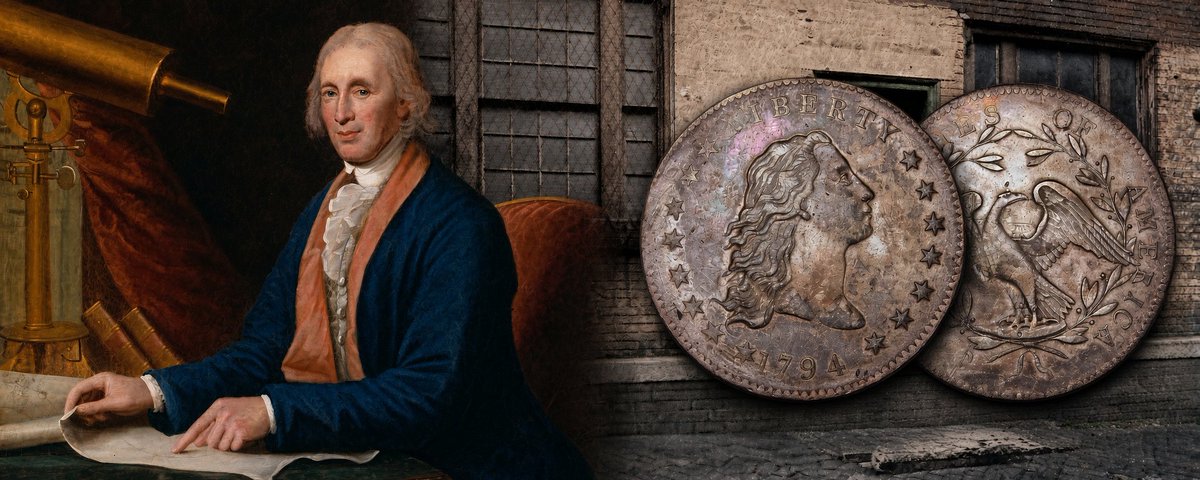
The other picture in that pair is the painted portrait the note returns to at his death. White hair, a telescope beside him, one hand on a sheet of figures. Charles Willson Peale painted him in 1796. The article sets the painting here, next to the appointment, and names the painter later.
A brick house on Seventh Street
Rittenhouse took the post in 1792. On 31 July he laid the cornerstone of a plain three-story brick house on Seventh Street, between Market and Arch. Offices faced the street. The furnaces and the presses sat in rooms at the back. It could have been any house on the block. It was the first mint the country had.
The cornerstone date is 31 July 1792. The law that created the mint was 2 April. The appointment card says 13 April. Three dates, one summer: a statute, a director, a stone in a wall. Nothing in that sequence says the coins were already in the street.
Copper first
Copper came out first. Cents and half cents were struck in 1793. A silver dollar was a harder job. The mint needed dies cut deep enough for a coin as wide as the Spanish one, and it needed an engraver who could sink them.
A cent is a small disc. A dollar as wide as the Spanish piece is a broad disc, and the die has to bite that width. The mint had a house in 1792 and copper coins in 1793. The dollar waited on the die.
The man who cut the steel
Robert Scot was that engraver. Born in Edinburgh, he had already cut plates in America for paper money, maps, and portraits. On 23 November 1793, he became chief engraver. The early dies were his work: steel sunk by hand, one punch and one line at a time.
A plate for paper is a surface cut to print. A die for a coin is steel sunk so a press can drive the design into metal. Scot arrived with the hand for that cutting. The office date in the note is 23 November 1793. The card embedded after that paragraph marks 2 October 1745 as his birth, and calls him the first chief engraver.
The same embed sets the coin beside the birthday. One picture is the face Scot cut for the dollar. The other is the back.
Liberty's hair is loose. The date is under the neck. On the back, the words run around the eagle.
Liberty, unbound
For the dollar he cut a head of Liberty with her hair loose. Collectors later named that look Flowing Hair. It is not a picture of a real woman. It is liberty with her hair unbound, ringed by fifteen stars, one for each state then in the Union. On the back he put a small eagle inside a wreath, and the words UNITED STATES OF AMERICA.
The name came later. The article is careful about that. Scot cut a head. Collectors, afterward, called the hair flowing. Nothing in the design is a portrait of a person who sat for it. Fifteen stars is a count of states, not a decoration added for balance. The back is a small eagle in a wreath, and the country's name. That is the whole of what the note claims for the die.
A press one size too small
The press could not quite do what the die asked. The biggest screw press in the house still could not strike a coin that wide hard enough in a single blow. On 15 October 1794, chief coiner Henry Voigt turned over 1,758 silver dollars. They went to Rittenhouse. They were the first silver dollars the United States had minted. The strike was soft, and dollar coinage stopped. The mint put its silver into half dollars instead.
A screw press drives the die into the blank by turning a screw. One blow is one strike. A coin as wide as the Spanish dollar asked for more force than that press could put into a single turn, and the weakness stayed in the metal. Soft, here, is not a judgment of the design. It is the article's word for a strike that did not fully take. Voigt's delivery is a count and a date: 1,758 dollars, 15 October 1794, handed to the director. Then dollar coinage stopped. The silver did not sit idle. It went into half dollars, a smaller piece the press could finish.
The second picture in that embed is the other side of the coin the card is talking about: the first dollars, struck at the Philadelphia house, 1,758 of them on that first day of dollar coinage.
One of them is in the Smithsonian
One of them is in the Smithsonian. The date, 1794, is under Liberty's neck. The loose hair is there. So is the weakness the press left in the metal: Scot's die never fully bit. People at the time could see it. The 1,758 pieces were specimens, not a river of new coin. Over the years a great many were melted. A 1794 dollar you can still hold is scarce.
A specimen, in the article's word, is an example, not a flood of coins filling every shop. People at the time could see that the die had not fully bitten. Melting, over the years, took a great many of the 1,758. Scarce means a 1794 dollar you can still hold. It is not a claim about a price.
Who stayed, and who left
Rittenhouse was already sick. He left the mint in 1795 and died in June 1796. That is the year Peale painted him, white-haired, a telescope beside him, one hand on a sheet of figures. Scot stayed at the bench until 1823. The brick house on Seventh Street struck the nation's coin until a larger mint opened in 1833.
Rittenhouse was gone from the office in 1795, and dead the next June. Scot was still cutting in 1823. The same brick building kept striking until 1833, when a larger mint opened. The article keeps those dates apart.
The dates in order
Statute, house, copper, then a soft silver dollar.
- 2 April 1792. Congress puts a mint in Philadelphia and defines the dollar as 371 and a quarter grains of pure silver, inside a coin of 416 grains. The rest is copper.
- 13 April 1792. The card in the article dates Washington's appointment of David Rittenhouse, clockmaker and astronomer, as the first director.
- 31 July 1792. Rittenhouse lays the cornerstone of a three-story brick house on Seventh Street, between Market and Arch. Offices in front. Furnaces and presses in the back.
- 1793. Cents and half cents are struck. On 23 November, Robert Scot becomes chief engraver. The card beside that fact marks his birth as 2 October 1745, in Edinburgh.
- 15 October 1794. Chief coiner Henry Voigt turns over 1,758 silver dollars to Rittenhouse. They are the first silver dollars the United States has minted. The strike is soft. Dollar coinage stops. Silver goes into half dollars.
- 1795 and June 1796. Rittenhouse leaves the mint, then dies. Peale paints him that year. Scot stays until 1823. The brick house strikes coin until a larger mint opens in 1833.
Close
Nothing about the start looked grand. An astronomer, a Scotsman cutting steel, a press one size too small, a doorway on an ordinary street. What came off that press on an October afternoon was still a piece of silver of a known weight, with the name of a country that had decided to mint its own.
Known weight is the 1792 sentence: 371 and a quarter grains of pure silver, in a coin of 416 grains. The name is the one Scot cut into the back, around a small eagle in a wreath. The afternoon is 15 October 1794, and the count is 1,758. The press was too small for a clean blow. The coins were still silver of a stated weight, with the country's own stamp. A brick house, and a dollar you could hold.
A shorter version of this note first appeared as an X Article.