
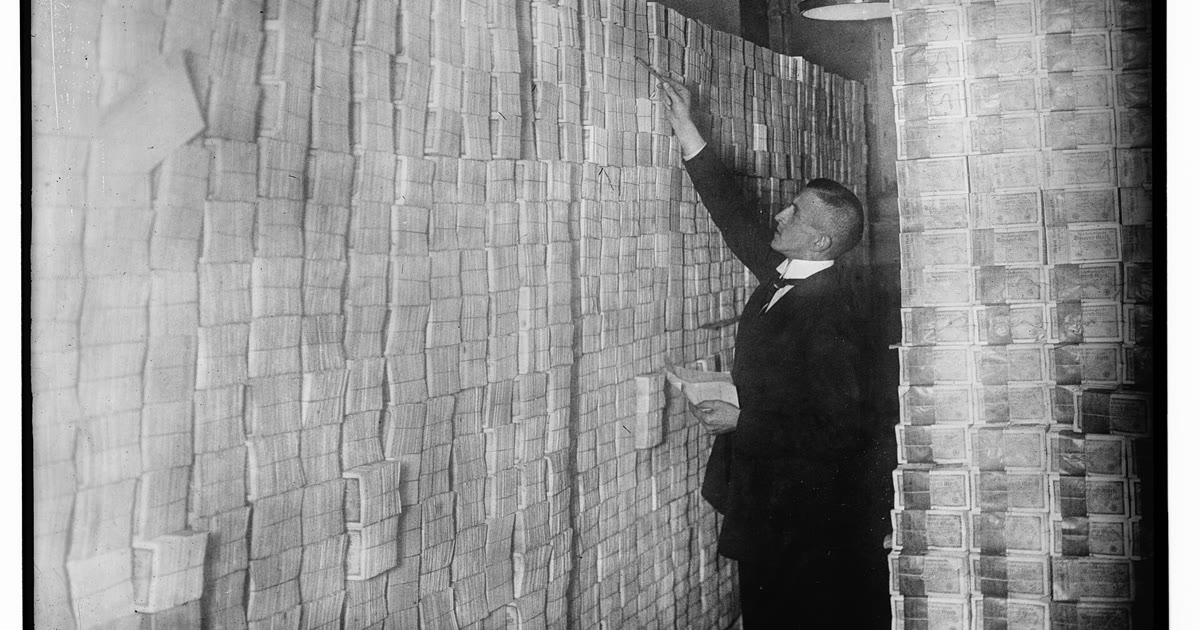
In the autumn of 1923, a German mark could buy less by the hour than it had bought that morning. Wages paid at noon were spent before supper, and café prices rose between the first course and the bill. By November a U.S. dollar — about 4.2 marks before the First World War — was quoted at roughly 4.2 trillion paper marks. Notes did not vanish. People stopped holding them and stopped pricing in them.
The paper mark had been failing as money through 1922–23, because war finance had removed the gold stop and Versailles had left a fiscal gap that the Reichsbank filled by creating marks against Treasury bills. The Ruhr occupation of January 1923 turned that gap into a spiral. Printing was the channel. The spiral ended in mid-November 1923, when the Rentenmark was issued at one trillion paper marks to one and the press stopped financing the Treasury as before.
War finance without a stop
Germany paid for the First World War largely by borrowing and expanding the note issue, rather than by taxation on a wartime scale, and gold convertibility ended with the war in 1914. The mark kept its gold name and lost the stop that had made the name honest. By the armistice the stock of paper was already several times the pre-war circulation, so controlled wartime prices hid part of the pressure. The black market did not.
Peace did not restore the old constraint. The republic inherited domestic war debt, social claims, and reparations payable in gold or in kind, and tax collection was too weak to cover them. The Reichsbank discounted Treasury bills — it created marks so the government could pay — and inflation was already visible in 1919–1921. That was still ordinary, if severe, inflation.
Hyperinflation is a later phase, roughly when prices rise about 50% or more in a month, and Germany crossed that line in mid-1922. Once expectations broke, the fiscal problem and the money problem fed each other: tax arrived in marks worth less than when the liability was assessed, and the gap was closed with more paper. Real cash balances collapsed as velocity exploded, because nobody would hold the unit. That is the mechanical core, not a morality play about “Germans printing money.”
A short timeline, 1914–1923
Exact daily rates vary by series. The order does not.
- July 1914. Gold convertibility ends for the war. The mark is still talked about as a gold unit. The public can no longer test that claim at the window.
- 1918–21. Armistice, Versailles, visible inflation. The Reichsbank keeps discounting Treasury paper. A dollar is already tens of marks, not 4.2.
- Mid-1922. Monthly price rises cross the usual hyperinflation threshold. The dollar rate leaves the hundreds for the thousands. Confidence in the mark as a store of value is gone.
- January 1923. France and Belgium occupy the Ruhr after defaults on deliveries in kind. Berlin answers with passive resistance and pays for it in new notes.
- Spring 1923. A brief attempt to hold the exchange rate burns reserves and fails. From late spring the monthly rates move into hundreds, then thousands of percent.
- Autumn 1923. The paper mark dies as a unit of account. Contracts move to foreign currency, gold-marks as a unit of calculation, or barter.
- 15–20 November 1923. The Rentenmark is issued. One trillion paper marks = one Rentenmark. The dollar is pinned at 4.2 in the new unit — the old parity under a new name. The press stops financing the Treasury as before.
The Ruhr and the final spiral
On 11 January 1923 French and Belgian troops occupied the Ruhr, Germany’s industrial core, and Berlin called for passive resistance: do not cooperate, because the Reich would cover wages. Production in the occupied zone fell and tax from the region dried up, so the wage and subsidy bill was met, again, by paper created through the Reichsbank.
There was a short intervention in the foreign-exchange market in early 1923, and the reserves were not large enough to hold it. When support ended, the slide resumed. By autumn, wholesale prices could rise on the order of 20% in a day at the peak. At that speed the “money supply” is not a stock anyone holds. It is a hot potato. C. H. Bresciani-Turroni’s contemporary account is still the place historians send readers for the monthly tables.
That is what it means for money to die as a unit: the notes remain in pockets and drawers, but contracts, wages, and shopkeepers abandon the paper mark for foreign currency, gold units, or goods.
How far the dollar rate ran
Pre-war parity was about 4.2 marks per U.S. dollar. By late 1922 the rate was already in the thousands, and through 1923 it moved through millions and billions into trillions. On the November stabilisation the official rate was set at 4.2 trillion paper marks per dollar — twelve zeros relative to the gold-mark parity.
Everyday prices followed that rate. A loaf of bread that cost a fraction of a mark before the war was in the hundreds of billions of marks by November 1923, and postage, tram fares, and café bills were revised so often that a price at the start of a meal was not the price at the end. Banknotes were overprinted with new face values because new plates could not keep up.
Exact multipliers differ by series — wholesale, retail, exchange. The qualitative fact does not: the paper mark ceased to work as a store of value or a unit of account.
Who lost, and who did not
Holders of cash, bank deposits, and nominal bonds in marks lost almost everything, and pensions and wages fixed in paper were destroyed unless they were rewritten daily. Debtors who owed marks saw the real burden of those debts evaporate, unless creditors had already switched the contract into a stable unit.
People and firms that held land, inventories, plant, foreign currency, or precious metal kept purchasing power relative to pure mark holders. That is not a ranking of virtue. It is what a collapsing unit of account does to balance sheets, which is why the political cost of that redistribution still sits in every serious history of the republic.
How the Rentenmark stopped it
Stabilisation needed two things together: a stop to marks created for the Treasury, and a unit people would accept. Mid-October 1923 decrees established the Deutsche Rentenbank, and Rentenmarks entered circulation from 15 November 1923, converted at one trillion paper marks to one Rentenmark. On 20 November the exchange rate was held at 4.2 Rentenmarks per dollar.
The notes were called “backed” by mortgages forced onto agricultural and industrial property, though a holder could not walk to a window and demand a weight of gold. The mortgages were a legal charge on land and plant — a way to make the new issue look limited — and not coin in a vault with a public claim on it.
The Reichsbank was barred from discounting government bills as before. Rudolf Havenstein, the Reichsbank president of the inflation years, died on 20 November, and Hjalmar Schacht, as currency commissioner and then Reichsbank head, enforced the new line. Contemporaries called the halt a miracle. The narrower fact is that once the public believed the press would not run for the Treasury, the old paper was scaled by a trillion and set aside.
In 1924 the Reichsmark succeeded the Rentenmark, and the Dawes Plan rearranged reparations and credit. Those are sequels. The hyperinflation of the paper mark ended in November 1923.
Printing was the channel, not the whole cause
Printing is how the stock expanded. It is not a complete cause. A government that can tax and that faces a hard stop — gold convertibility, a currency board, a public that will not accept more notes — cannot do this for long. Weimar had a fiscal gap it would not close, a central bank that monetised Treasury paper, a lost war, reparations, and then the Ruhr. Remove the stop, keep the spending, and the unit fails.
It is a documented extreme, not a script every paper currency has to finish. The paper mark died because a stop was missing and a government kept spending through the gap. When the Rentenmark put a stop back, the spiral stopped within weeks.