
The Second Bank of the United States was a privilege written into a federal charter: private stockholders owned most of it, while the United States owned a share, named directors, and kept the Treasury’s cash in its vaults. The Bank issued notes that passed from hand to hand and could present the notes of state banks for gold or silver, so whoever held those public balances could lend on them.
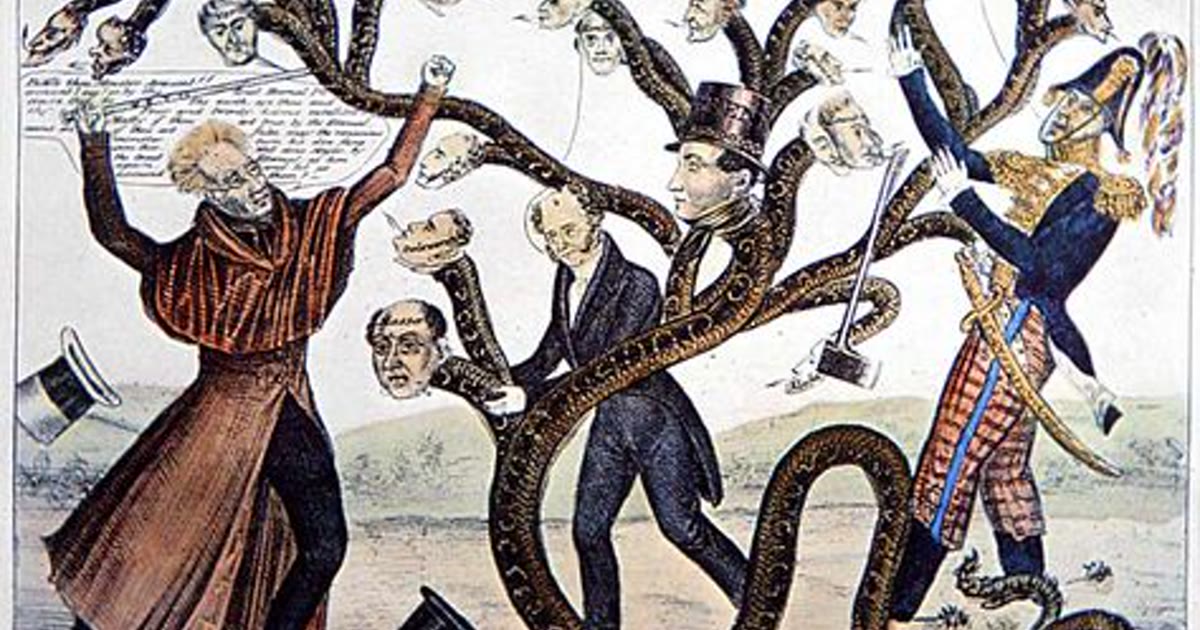
A corporation with a federal seal and the government’s account was not a neutral warehouse for coin. It was a favored issuer sitting on the country’s cash, which is what the cartoons and the campaign were about.
The charter of 1816
Congress had tried the arrangement once. The First Bank of the United States ran from 1791 to 1811 and was not renewed. After the War of 1812, with the Treasury short and many state banks refusing to redeem their notes, James Madison signed a new charter in April 1816. The Second Bank opened in Philadelphia in January 1817, for twenty years, with a capital of $35 million. Twenty-five directors governed it, five appointed by the president and the rest elected by the stockholders, and branches followed the settlement west until there were twenty-five of them.
Nicholas Biddle became president in 1823. The Bank held federal deposits, paid the government’s bills, and issued its own notes, and it also accumulated the notes of state banks so it could present them for coin. Supporters called that discipline. Critics called it a monopoly with politics attached. It was not a lender of last resort, and it did not hold the banking system’s reserves; it was large, chartered, and close enough to the Treasury to loosen or tighten credit with other banks’ notes and with the public cash.
The veto of 10 July 1832
A recharter bill went to Congress in January 1832, four years before the charter expired, because Henry Clay was among those who wanted the question forced before the election. Both houses passed it, and Jackson sent it back on 10 July 1832.
The veto message, in the wording of A Compilation of the Messages and Papers of the Presidents (1897), as transcribed by the Avalon Project at Yale Law School, says: “It is to be regretted that the rich and powerful too often bend the acts of government to their selfish purposes.” The same paragraph speaks of using the laws “to grant titles, gratuities, and exclusive privileges, to make the rich richer and the potent more powerful,” and it closes on the bill itself: “In the act before me there seems to be a wide and unnecessary departure from these just principles.” Citing papers already before Congress, the message put foreign holdings at $8,405,500 of the $28 million in private stock on 1 January 1832, mostly in Britain.
That is an attack on exclusive privilege, not a plan that moves the Treasury onto coin or stops banks from issuing notes. Congress did not override the veto. Jackson won reelection that autumn, and Biddle still ran the Bank under the old charter, so only the renewal was dead.
Where the deposits went
The veto left the public money where it was. After the election Jackson ordered it out of the Bank. By late 1833 most of the federal deposits sat in selected state banks, called pet banks. The cash did not become coin in a government vault. It became balances at banks that issued notes and made loans. One privilege had been broken into several, and the pieces were easier to expand.
Biddle did not replace the lost deposits with new private funds. He limited credit and called in loans through 1833 and 1834, counting on the squeeze to force the Treasury back. Credit tightened in the commercial cities. The contraction won no recharter. In April 1834 the House voted to leave the deposits with the state banks and not to renew the Bank. Calling in loans showed what the critics had claimed: one corporation could make money scarce.
Land offices in the West were selling fast, and the buyers often paid with bank notes. In 1836 the Specie Circular instructed those offices to take gold or silver. That was a hard-money brake on paper land sales. It was also a sudden demand for coin from banks that had already lent against the boom. The federal charter expired the same year.
Panic of 1837
In 1837 the break came. Banks suspended specie payments. Failures spread among merchants and among the state banks that had been holding public money and lending it out as notes. Cotton prices and credit from Britain were part of the strain. They do not replace the domestic sequence. Public cash had left the chartered bank for banks that multiplied paper, and the Specie Circular had then asked those banks for metal.
Jackson is not the hero of what followed. He had named the Bank’s exclusive privilege and refused to renew it. He had not put a scarcer money in its place. The deposits sat where new notes could be written against them. The panic is what that paper, joined to a government cash account, produced: a boom in promises, then a demand for coin the promises had already outrun.
The Philadelphia institution continued under a Pennsylvania charter and failed in the early 1840s. The United States went on for the rest of the century without a federally chartered central bank, and it did not go on without paper. In the 1860s the Union paid its bills in greenbacks. Seventy years after 1837, the Panic of 1907 put a central bank back before Congress, which passed the Federal Reserve Act in 1913.
A short timeline
The charter, the veto, the deposits, the metal, the panic.
- 1816–17: Congress charters the Second Bank; it opens in Philadelphia with a capital of $35 million.
- 10 July 1832: Jackson vetoes recharter. He is reelected that autumn. The old charter still runs.
- Late 1833: Most federal deposits have been moved to selected state banks, the pet banks. Biddle calls in loans.
- 1836: The Specie Circular requires gold or silver for public land. The federal charter expires.
- 1837: Panic. Banks suspend specie payments.
- 1913: Federal Reserve Act, after the Panic of 1907.
Privilege, then a scatter of paper
The fight is remembered as Jackson against the Bank. The stake was custody. Whoever held the Treasury’s balances could lend on them, and whoever issued the notes other banks had to honor could discipline everyone else’s paper. The charter had given both to one corporation.
The veto refused that grant. It did not make the money harder to multiply. The privilege was real. Scattering the public cash into note-issuing banks was not sound money.