
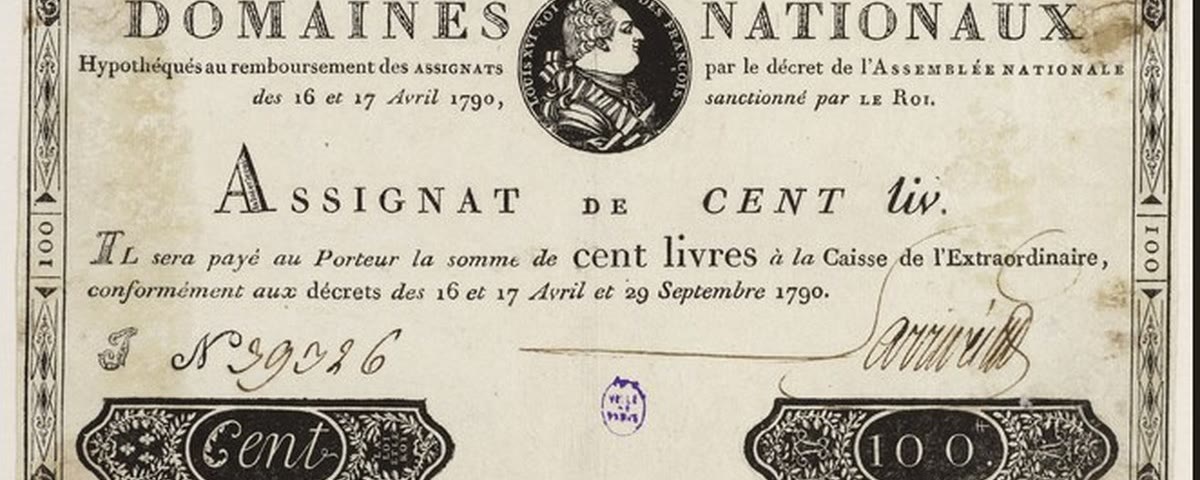
By 1795, shops in revolutionary France quoted two worlds: a paper price that moved by the week, and a coin price people preferred. Assignats, notes first issued in 1789–90 and supposedly retired by sales of seized church and émigré land, still filled drawers, but they no longer did the work of money, and the Directory was already returning toward metal.
The land behind those notes was real, and the promise was that paper would come back in as land went out, yet the quantity rose faster than retirement. France paid its way in that paper for about six years, then abandoned it.
Paper against land to be sold
The National Assembly inherited a broken treasury, and in November 1789 it placed church property at the disposal of the nation. That stock, later enlarged by émigré estates, became the biens nationaux. The first assignats, decreed in December 1789, were large, interest-bearing paper: more a state claim to be paid from land sales than a daily note.
A warehouse receipt still named metal at a window, and a Bank of England note was a circulating promise to pay coin, subject to the Bank’s rules, but an assignat was a state liability whose advertised stop was land to be sold rather than coin on demand. You could not walk to a vault and demand a posted weight. You were told the land was there, and that sales would retire the paper.
The land story was the political sale, because metal was scarce in the till and land was visible. If the paper was a claim on that land, the argument ran, it could not become worthless. Land can be real and still fail as a stop if issue is not retired and no window pays a fixed thing.
From bond to currency
In April 1790 the paper was recast as circulating money: interest was cut and then removed, and denominations fell until assignats could pay wages and buy bread. What had been a fiscal instrument for absorbing debt became the everyday unit.
The Assembly treated quantity as a vote. In September 1790 a large new issue was added and called a ceiling, and the ceiling did not hold. Later years added more paper against the same land story, then against war. Once small notes exist, the state can pay in its own slip, and retirement becomes a hope about future sales rather than a nightly burning that matches the press.
Authorized totals moved from a few hundred million livres in the first decrees toward tens of billions by the mid-1790s. Series disagree on the last digit. The order does not: issue outran the sales meant to cancel it.
Quantity outran retirement
The advertised mechanism was simple: sell a parcel of the biens nationaux, take assignats in payment, and destroy those notes, so the stock of paper falls as the stock of unsold land falls. In a clean ledger that could work.
The ledger was not clean. Sales were slower than new decrees, and buyers paid in the same paper the state was still printing. Burning some notes while issuing more is not a stop: the land remained while the claim on it multiplied, and a backing story without a hard limit on issue does not retire the paper.
Prices in assignats rose, and metal went to a premium, then out of sight. Shops quoted two worlds: a paper price that moved, and a coin price that people preferred. That is the ordinary death of a unit — not a missing acre on a map, but a public that will not hold the slip.
War, the Maximum, and a dead unit
In April 1792 France went to war, and armies, contractors, and the later levée en masse were paid in new assignats, so revolution at home and war abroad used the same press. The Terror’s Maximum (1793–94) tried to freeze prices in paper. Controls can hide a price for a time, but they do not retire paper, and after Thermidor the Maximum was repealed and the hidden price became the street price.
By 1795 the assignat was failing as a store of value and as a unit of account, and markets reached for coin, barter, or foreign units. In February 1796 the printing plates were destroyed in public, though the Directory had already begun to live with metal again. A brief sequel, the mandats territoriaux, tried another land paper in 1796 and died in months. That is a postscript, not a second System.
The paper did not vanish from drawers; it ceased to be money. France returned toward specie by abandoning the assignat, not by promising to redeem the same notes later at an old metal definition.
A short timeline
Exact issue totals vary by series. The order does not.
- November 1789. Church property placed at the nation’s disposal — the first biens nationaux.
- December 1789. First assignats: large, interest-bearing paper against future land sales.
- April 1790. Recast as circulating money; interest cut, then removed; smaller notes follow.
- September 1790. A large new issue; the Assembly calls the total a ceiling. The ceiling does not hold.
- April 1792. War; the press becomes war finance as well as land finance.
- 1793–94. The Maximum tries to freeze paper prices; after Thermidor the controls go.
- 1795–February 1796. The unit dies; plates destroyed; the Directory returns toward metal.
- 1796. Mandats territoriaux: a short second land paper, then gone.
Land on the advertisement, press in the till
Once a state could pay in its own land-tied slip, the issuer could be leaned on. The Revolution needed a till and the wars needed a larger one, and the press, not the biens nationaux advertised as the limit, was what actually filled them.
France had already lived through one paper disaster: John Law and the Mississippi Bubble in 1720. The Revolution did not revive that bank-and-company machine. It issued state paper with a land story — and still printed faster than sales could retire it.
Across the Channel, the same wars strained the Bank of England. In 1797 London stopped gold payout on Bank notes; those notes stayed everyday English money, and resumption in the 1820s brought the window back. England suspended and resumed. France’s paper died.